

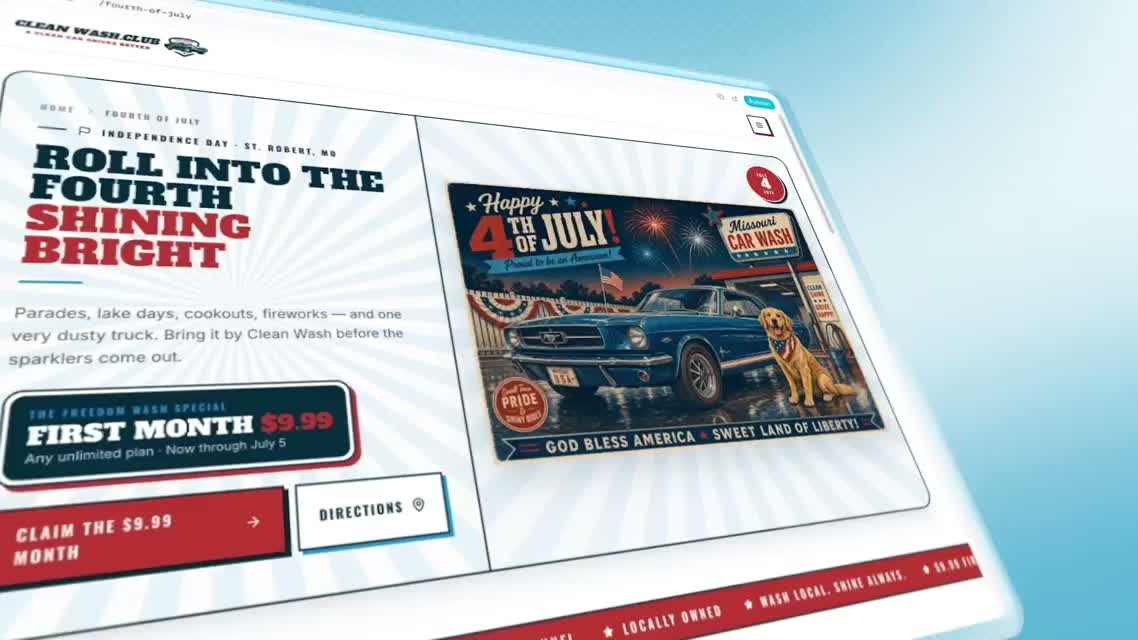
Before Nautilus, Amayr and I built custom websites for car wash customers to help pay for college tuition.
That work became one of the earliest bones of Nautilus. When we onboarded our first customers, we often included a free website that we designed and built ourselves. It was a practical way to help an operator start selling online, and it taught us how much of the customer experience begins before a vehicle ever reaches the pay station.
Over time, those projects became thousands of hours spent building, updating, hosting, editing, managing, and refining websites for car washes.
Shipyard is what came out of doing that work by hand for years.
The website problem is really an operating problem
Too many car wash operators do not have real control over one of their most important growth channels.
A new landing page means waiting on an agency. A pricing update means submitting a request. A campaign means coordinating copy, design, development, checkout, tracking, and attribution across different people and systems.
That process breaks down when offers, locations, weather, and the marketing calendar are changing every week. The website becomes a ticket queue instead of a tool the business can operate.
We saw the same friction repeatedly while maintaining sites ourselves. The problem was not simply that pages took too long to design. The website was disconnected from the systems that actually sold and supported memberships.
Why a generic website builder was not enough
Car wash websites have their own operating patterns.
Operators need location pages that make hours, directions, and amenities easy to find. They need wash packages that explain the difference between retail washes and recurring memberships. They need unlimited-club offers, campaign landing pages, lead forms, and a clear path for existing members to manage their plans.
They also need those pages connected to the rest of the customer journey. A membership button should open the right checkout flow. A campaign page should line up with the offer being measured. A Manage My Membership link should send the customer into self-service instead of back to the site office.
Those are not generic design preferences. They are the working parts of a car wash's customer operation.
Shipyard is built around that playbook: the patterns we learned across years of real car wash projects, turned into a system that can apply them in each operator's brand.
From an existing URL to a working site
Shipyard starts with the website an operator already has.
Paste in the URL and the agent extracts the existing brand: colors, fonts, logo, copy, imagery, and page structure. It uses that material to rebuild the site as a modern, multi-page experience rather than forcing the operator to begin with a blank template and a long creative brief.
From there, iteration happens in plain English:
Add the unlimited club offer.
Build a landing page for the Fourth of July campaign.
Make the package section full width.
Each request creates a versioned deployment with a live preview. The team can inspect the change, compare versions, roll back, and promote the approved build to a Shipyard subdomain or its own domain.
The goal is not to remove judgment from the website. It is to make changing the website feel like a conversation instead of a project plan.
The website layer for Nautilus
The biggest difference is what sits behind the page.
Shipyard is the website layer for Nautilus, so a site can connect directly to the systems around it:
- membership packages can lead into Nautilus storefront checkout
- existing members can reach the customer portal for self-service
- campaign pages can support CRM workflows and attribution
- new pages can use the same customer and offer infrastructure as the rest of Nautilus
That turns the website from a brochure into an operating surface. It can help acquire the customer, sell the membership, route the existing member, and carry campaign intent into the systems that measure what happened next.
Built from real car wash work
We did this work by hand for years. The sites already running on customer domains show what that experience looks like across very different brands:
Each one is recognizably its own business. Shipyard brings the car wash playbook. The operator brings the brand, locations, offers, and judgment.
What we are building toward
The first version of Shipyard makes website creation and iteration dramatically more direct. The longer-term opportunity is larger.
Over time, we want Shipyard to understand more of the context around an offer, a visitor, and the result. The opportunity is a tighter loop between campaign creative, memberships, checkout, attribution, and what actually performs after the click.
That is why we built Shipyard. Not to make another generic AI site generator, but to give car wash operators control over the website layer of their business.
Your website should be an operating surface, not a ticket queue.